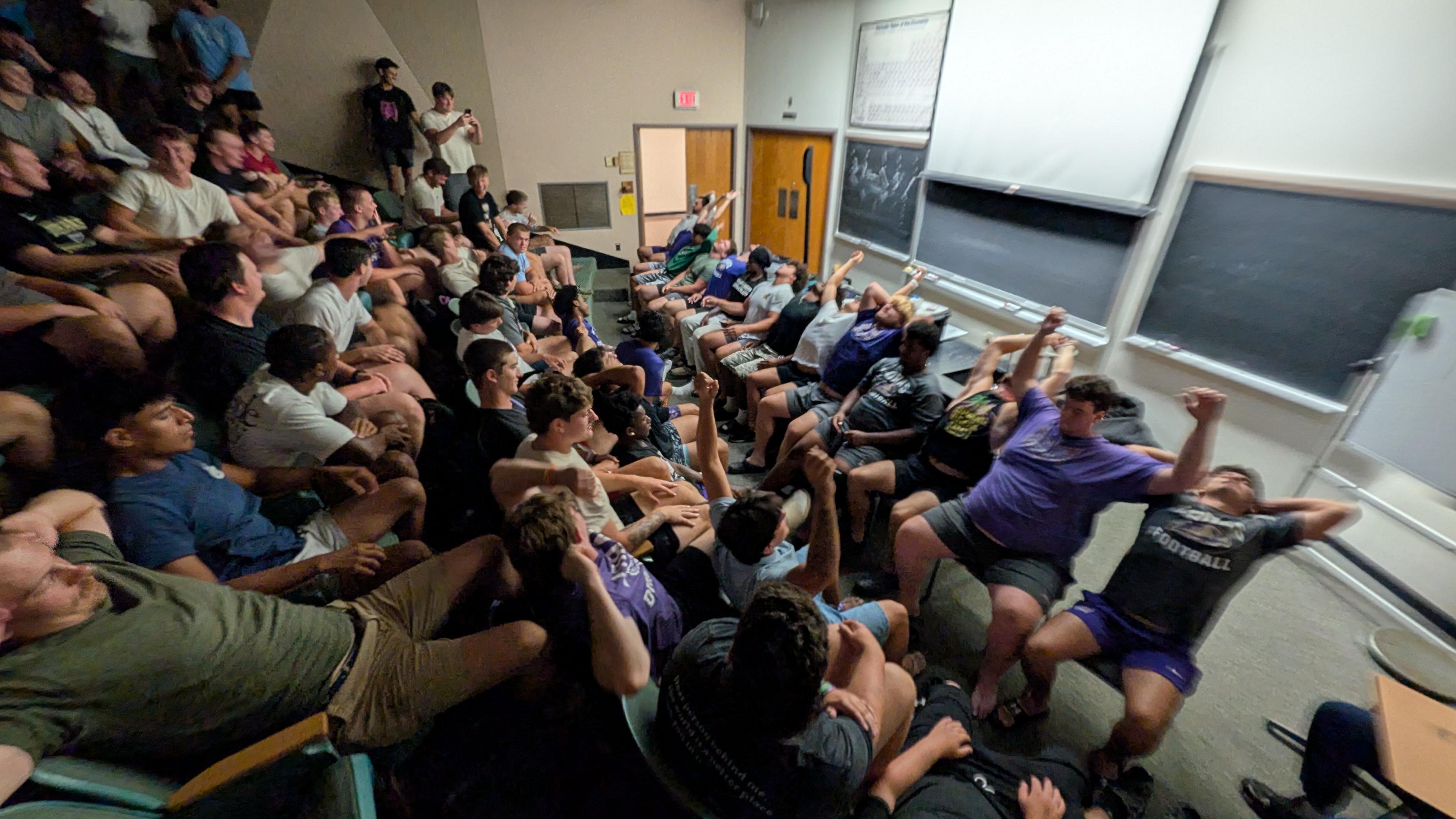
The Short Answer
There is no single secret. There is a rhythm. An audience stays with you when something meaningful changes every 90 seconds and when every person believes they might be part of whatever happens next.
Hold those two things and you can keep a room of 1,200 people off their phones for an hour. Lose either one and you will lose the back third of the room in the first ten minutes.
I am Randy Andrews, a nationwide comedy hypnotist, comedy mentalist, and keynote speaker performing for corporate events, colleges and universities, and high schools across the country. After more than 1,500 live shows, I have had thousands of chances to get this wrong and learn from it. Here is everything I would tell a fellow performer, speaker, or trainer over coffee.
Seven Rules That Hold Any Room
- Change something every 90 seconds. Voice, pace, position on stage, who is talking, what the audience is looking at. Attention does not renew on its own. It renews on change.
- Make participation possible, never mandatory. The instant a room believes it might get called on, everyone pays attention. The instant a room believes it will be forced to, everyone shuts down. Those are two different feelings and the gap between them is everything.
- Earn the room before you ask it for anything. I do not ask for a single volunteer until the audience has already laughed with me several times. Nobody takes a social risk for a stranger they have not decided they like yet.
- Talk to individuals, not to the crowd. Pick one person, finish a full thought with them, move to someone else. A room of 800 is 800 individuals who each want to feel spoken to. "You guys" reaches nobody.
- Protect whoever participates. How you treat the first volunteer determines whether you get a second. If the room senses you might make someone look foolish, hands stop going up permanently.
- Respect the energy curve. Every audience has a natural dip about two thirds of the way through. Plan your strongest material for it instead of hoping it will not happen.
- Finish early rather than late. Leave them wanting more. An audience remembers how a show ended far more clearly than how long it ran.
None of that requires a specific art form. It works for a keynote, a training session, a sales kickoff, or a comedy show.
Audience engagement depends on two factors: meaningful variation roughly every 90 seconds, and a genuine possibility of participation without any obligation to participate. Rooms disengage when the content becomes predictable or when attendees feel they might be forced into an uncomfortable moment.
The Room Fights You Before You Say a Word
A huge share of engagement is decided by the setup, and it gets decided before anyone walks in. If you are the one planning the event, this section is worth more to you than the seven rules above.
- Lighting on the audience matters as much as lighting on the stage. If I cannot see faces, I cannot read the room, and I cannot adjust. A fully dark house is a wall.
- Round tables are a real problem. Half your guests have their backs to the front. Ask the venue to angle chairs during the room flip.
- Sound has to reach the back wall clearly. Not loudly. Clearly. A room that strains to hear will quit listening within five minutes.
- Empty rows at the front kill energy. Rope off the back instead. A tight room feels alive and a spread-out room feels empty even at the same headcount.
- Never put the entertainment against the bar. Whatever competes with you will win, because it is closer to them.
I bring this up with every planner during our first call, and it comes up again on my FAQ and safety page. Fixing the room is cheaper than fixing the show.
Why Participation Beats Performance at Scale
Here is the part most speakers underestimate. As a crowd grows, individual attention gets harder, not easier, because the audience becomes more anonymous to itself.
Participation solves that. When somebody the audience recognizes walks onto the stage, the room reconnects instantly. Now they are not watching a performer. They are watching Dave from accounting, and Dave is a much bigger deal to them than I will ever be.
That is the entire engineering behind a comedy hypnosis show and a comedy mentalism show. The format has audience investment built into its structure instead of relying on the performer to generate it every few seconds.
How to Read a Room in Real Time
Adjusting live is the skill that separates a good set from a great one. These are the signals I watch for constantly:
- Laughter that arrives late. The room is thinking too hard. Simplify immediately.
- Phones coming out in clusters. Something ran too long. Cut to the next change.
- Side conversations starting near the back. You lost the perimeter. Move physically toward it.
- Silence with eye contact. This one is good. That is a room leaning in, not a room checking out.
- Applause that starts before you finish. They are ahead of you. Speed up.
Every one of those is fixable within thirty seconds if you are watching for it. None of them is fixable if you are looking at your notes.
Reading an audience live means monitoring specific signals: delayed laughter indicates content is too complex, clustered phone use indicates a segment ran too long, and side conversations at the back indicate the perimeter of the room has disengaged. Adjustments made within thirty seconds recover a room that would otherwise be lost for the remainder of the program.
The Mistake I See Most Often
Speakers and performers front-load their best material and then coast. Audiences do the opposite of coasting. They get harder to hold as the night goes on, because they are more tired and more full.
Build the show so the last fifteen minutes are the strongest fifteen minutes. That is the section your audience will describe to their coworkers on Monday, and it is the section that determines whether they come back next year. Corporate planners see this in their attendance numbers year over year, which I write about on the corporate event entertainment page.
Frequently Asked Questions
How do you engage an audience that does not want to be there?
Acknowledge it early and honestly, then give them something to react to within the first two minutes. Captive audiences resent being sold to and respond quickly to being entertained. The fastest fix is participation, because it converts an obligation into an experience.
What are the best audience participation techniques for large crowds?
Start with seated participation that involves everyone at once, then move to individual volunteers only after the room has warmed up. Keep participation voluntary, protect anyone who steps forward, and make sure the first volunteer has a great experience so others follow.
How long can you hold an audience's attention?
Far longer than the commonly quoted figures suggest, as long as something meaningful changes every 90 seconds or so. I regularly hold rooms for 60 to 90 minutes. Attention fails from predictability rather than from elapsed time.
What is the best entertainment for a large crowd?
Interactive formats scale better than passive ones, because they give a big anonymous room a shared focal point that everyone already knows. Comedy hypnosis works especially well above 300 people, since the visual holds even at long sightlines.
Do these techniques work for a training session, not just entertainment?
Yes, and the rhythm rules matter even more in training, because the content is heavier. Change something every 90 seconds, keep participation genuinely optional, and put your most important point in the final segment rather than the first.
When You Want the Room Handled for You
Sometimes you do not need a technique list. You need someone who has done this a few thousand times to take the room off your hands for an hour so you can breathe. Planners describe how that felt on my reviews and past clients page.
Check AvailabilityBased in Iowa and performing nationwide across 40+ states, Randy Andrews delivers comedy hypnosis, comedy mentalism, and keynote speaking for corporate events, colleges, high schools, and fundraisers. Find your city or region and see what planners in your market say about the show.